Understandably, youth unemployment has been the topic du jour this week. Many have offered insights into causes and solutions, based either on supply or demand side arguments.
On the supply side, causes are identified as lack of appropriately skilled and experienced youth who are work ready with an acceptable work ethic. On the demand side, there are few jobs available in Tasmania for our youth. From the perspective of solutions, on the supply side is to increase investment in educational attainment and on the demand side, create confidence in the economy and thus jobs.
While from a helicopter view, these explainers for the causes and solutions of high levels of youth unemployment are well supported, greater understanding of the interaction between education and its influence on employment outcomes is required.
Critically there is a misconception about who of our youth is unemployed. Assumptions are that it is those who have low levels of educational attainment, particularly literacy and numeracy. While there is a proportion of our youth who do fit this description, there are many recent graduates (and not quite complete apprentices) who fill the unemployment queue, particularly in Tasmania. This is primarily due to the mismatch between educational qualifications and employment opportunities, including whether or not educational qualifications prepare an individual for the workplace. Many argue that tertiary education does not. This leads to our youth being overqualified and under-experienced. Eventually these overqualified people leave the state, adding to our population challenges.
Even tertiary educated individuals require on-the-job training to get them in a position where they make a positive, productive contribution to the business - this period of training is an investment (cost) to the employer and can take many years to achieve (around three years for most occupations). In order for an employer to take on either an apprentice/trainee or a recent graduate they need confidence in the (long term) market to achieve a return on this investment. In Tasmania three years is a long time to invest getting an employee to productive stage. It also means freeing up resources (skilled people, time and money) to train individuals, meaning those resourced are also not fully productive.
So what do we do? Take a step back and reassess - focus on three areas of responsibility: education, integration between education and employment and employers.
1) The foundations of literacy and numeracy are critical. Unless these levels meet national standards, employment will be difficult for individuals (at any time of their life). Our youth needs to want to be educated. They need to be surrounded by jobs to which they aspire to do, jobs which require completion of year 12 and further education. High school must go to year 12. Subject choice needs to be reduced. The foundations of education; literacy, numeracy, problem solving, critical thinking, expression and creativity are the priority. A large subject choice narrows students abilities and choices in the future. In an economy always changing and with occupations no longer guaranteed to exist in 10 years time, our youth need solid foundation skills and abilities. This will widen their opportunities in the future.
2) There is complete miscommunication between industry and education providers with regard to skills and abilities required in the workplace, partially to blame is the way in which education is funded. In any case, both industry and education providers have a responsibility to each other, to prospective students and employees about expectations and outcomes.
Efforts to improve educational attainment are evident, however, the recently signed MoU between TasTAFE and UTAS includes increasing the level of educational attainment and the number of completions, however, it does not include securing employment by graduates in its scope. There is little point the state investing in the education and skill development of Tasmanian-based students if they can not be retained in the state (essentially we are investing in the future prosperity of another state). Furthermore, while UTAS has introduced a formal internship process for international students with the objective of retaining them in the state upon completion, aimed at completing the link between education and employment, the same internship process is not available for Tasmanian students.
3) Employers also need to adapt and compromise. This is particularly evident in the type of entry level jobs offered to our youth. While our teaching styles have evolved over time to encourage independent thinking, using initiative and problem solving, entry level jobs have not adapted to these new skills and abilities offered by our youth (I wrote more about this here). Accusations of youth being transient and unloyal are the direct result of lack of job security offered in employment. While businesses mitigate against future risks by offering less than permanent employment, youth also mitigates their risks by continuing to pursue employment opportunities which will provide security (or increased experience).
A final, important point, is that our youth are our future, and always will be.
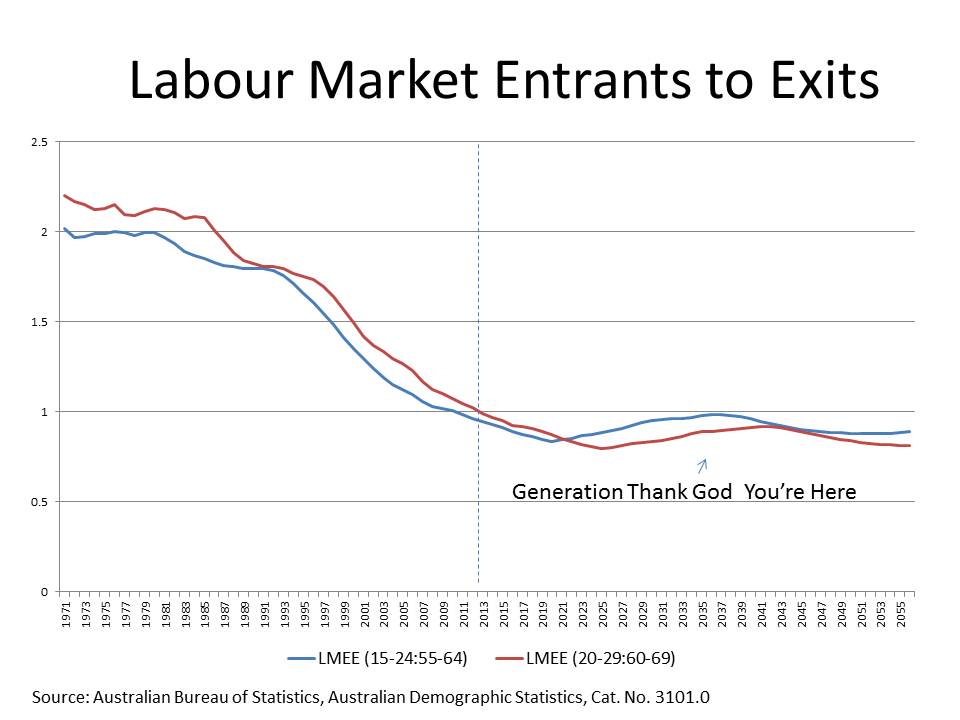
Solutions to the challenges of population ageing forget about the opportunities provided by our youth and future generations. As we enter a period of time in which there will be more labour market exits (due to the large cohort of baby boomers reaching retirement age) than labour market entrants, maximising the utilisation of the available supply of labour is paramount. In Australia, the focus is on increasing the labour force participation rate of women and older ages (as well as productivity). This solution does not consider the contribution of youth at all.
In fact, since the early 2000s Australia, and to a lesser extent, Tasmania, has been experiencing a mini-baby boom. Critically, this cohort of children will enter the labour market as the last of the baby boomer reach retirement age (around 2023). This generation is what my colleagues, Brendan Churchill and Natalie Jackson, and I call the Thank God You're Here Generation (Gen TGYH). Gen TGYH will be the replacement labour that we are so desperately seeking. However, they are not round pegs who will fit in round holes (left vacant by baby boomers). Gen TGYH need to be shaped and nurtured to meet our future needs.
It is the responsibility of parents, educators and employers to ensure that Gen TGYH and subsequent generations have strong foundations on which to build knowledge, skills, flexibility and adaptability as well as build a career.
On the supply side, causes are identified as lack of appropriately skilled and experienced youth who are work ready with an acceptable work ethic. On the demand side, there are few jobs available in Tasmania for our youth. From the perspective of solutions, on the supply side is to increase investment in educational attainment and on the demand side, create confidence in the economy and thus jobs.
While from a helicopter view, these explainers for the causes and solutions of high levels of youth unemployment are well supported, greater understanding of the interaction between education and its influence on employment outcomes is required.
Critically there is a misconception about who of our youth is unemployed. Assumptions are that it is those who have low levels of educational attainment, particularly literacy and numeracy. While there is a proportion of our youth who do fit this description, there are many recent graduates (and not quite complete apprentices) who fill the unemployment queue, particularly in Tasmania. This is primarily due to the mismatch between educational qualifications and employment opportunities, including whether or not educational qualifications prepare an individual for the workplace. Many argue that tertiary education does not. This leads to our youth being overqualified and under-experienced. Eventually these overqualified people leave the state, adding to our population challenges.
Even tertiary educated individuals require on-the-job training to get them in a position where they make a positive, productive contribution to the business - this period of training is an investment (cost) to the employer and can take many years to achieve (around three years for most occupations). In order for an employer to take on either an apprentice/trainee or a recent graduate they need confidence in the (long term) market to achieve a return on this investment. In Tasmania three years is a long time to invest getting an employee to productive stage. It also means freeing up resources (skilled people, time and money) to train individuals, meaning those resourced are also not fully productive.
So what do we do? Take a step back and reassess - focus on three areas of responsibility: education, integration between education and employment and employers.
1) The foundations of literacy and numeracy are critical. Unless these levels meet national standards, employment will be difficult for individuals (at any time of their life). Our youth needs to want to be educated. They need to be surrounded by jobs to which they aspire to do, jobs which require completion of year 12 and further education. High school must go to year 12. Subject choice needs to be reduced. The foundations of education; literacy, numeracy, problem solving, critical thinking, expression and creativity are the priority. A large subject choice narrows students abilities and choices in the future. In an economy always changing and with occupations no longer guaranteed to exist in 10 years time, our youth need solid foundation skills and abilities. This will widen their opportunities in the future.
2) There is complete miscommunication between industry and education providers with regard to skills and abilities required in the workplace, partially to blame is the way in which education is funded. In any case, both industry and education providers have a responsibility to each other, to prospective students and employees about expectations and outcomes.
Efforts to improve educational attainment are evident, however, the recently signed MoU between TasTAFE and UTAS includes increasing the level of educational attainment and the number of completions, however, it does not include securing employment by graduates in its scope. There is little point the state investing in the education and skill development of Tasmanian-based students if they can not be retained in the state (essentially we are investing in the future prosperity of another state). Furthermore, while UTAS has introduced a formal internship process for international students with the objective of retaining them in the state upon completion, aimed at completing the link between education and employment, the same internship process is not available for Tasmanian students.
3) Employers also need to adapt and compromise. This is particularly evident in the type of entry level jobs offered to our youth. While our teaching styles have evolved over time to encourage independent thinking, using initiative and problem solving, entry level jobs have not adapted to these new skills and abilities offered by our youth (I wrote more about this here). Accusations of youth being transient and unloyal are the direct result of lack of job security offered in employment. While businesses mitigate against future risks by offering less than permanent employment, youth also mitigates their risks by continuing to pursue employment opportunities which will provide security (or increased experience).
A final, important point, is that our youth are our future, and always will be.
Solutions to the challenges of population ageing forget about the opportunities provided by our youth and future generations. As we enter a period of time in which there will be more labour market exits (due to the large cohort of baby boomers reaching retirement age) than labour market entrants, maximising the utilisation of the available supply of labour is paramount. In Australia, the focus is on increasing the labour force participation rate of women and older ages (as well as productivity). This solution does not consider the contribution of youth at all.
In fact, since the early 2000s Australia, and to a lesser extent, Tasmania, has been experiencing a mini-baby boom. Critically, this cohort of children will enter the labour market as the last of the baby boomer reach retirement age (around 2023). This generation is what my colleagues, Brendan Churchill and Natalie Jackson, and I call the Thank God You're Here Generation (Gen TGYH). Gen TGYH will be the replacement labour that we are so desperately seeking. However, they are not round pegs who will fit in round holes (left vacant by baby boomers). Gen TGYH need to be shaped and nurtured to meet our future needs.
It is the responsibility of parents, educators and employers to ensure that Gen TGYH and subsequent generations have strong foundations on which to build knowledge, skills, flexibility and adaptability as well as build a career.